
Helen Parkinson
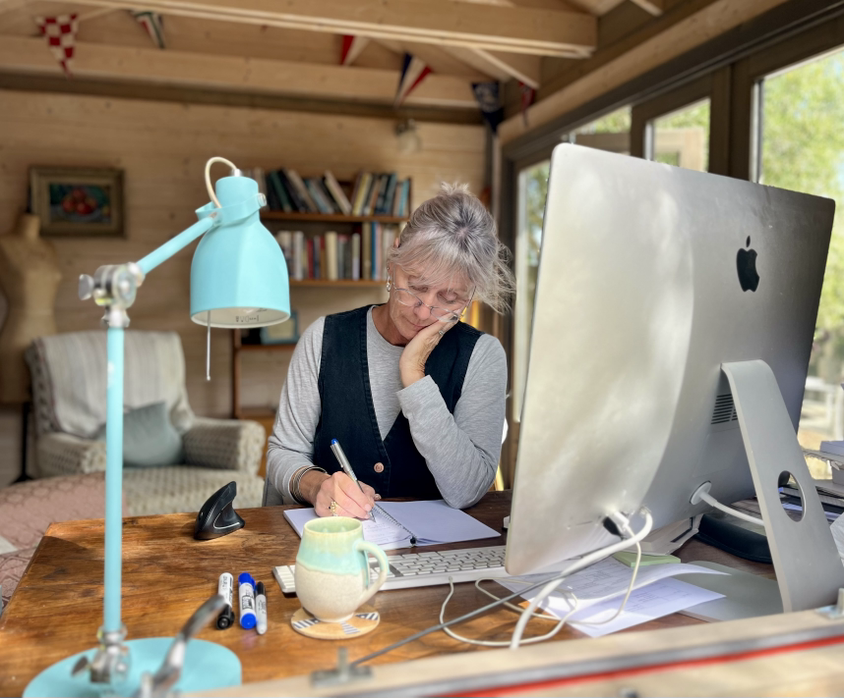
Join Helen for her Open Studio Event
Join our intensive writing mentoring residency guest Helen Parkinson for her open studio weekend. There will be a chance to hear about her embodied investigations during her writing residency and to hear a fragmented reading of her Work in progress.
Open Studio 12-5pm Sat & Sun with reading and Q&A on Sunday 3-5pm
Intensive Writing Mentoring Residency
November 2025
Touching story...
I am currently working on a novel that revolves around an artist who is steeped in the tactile world of paint, clay and canvas. To truly inhabit her life, I’m eager to step away from the laptop and experience the feel of a brush across canvas, the cool give of wet clay, and the unexpected way colours mingle on a palette. I want to immerse myself in the resistance and the mess of creating something tangible, so her world doesn’t just live in my head, but in my skin.
Another voice in the novel belongs to a woman who is incarcerated – the last few weeks of her life shaped by the confines of four walls, both physically and psychologically. A world in stark contrast to the artist and yet between them runs a strange current that skips across a century. It is an uncanny tethering, an almost bodily connection that I should like to explore. As yet, I am unsure how I will achieve this, or even if I will. However, this residency will give me the freedom to try different materials and forms, and by uncoupling me from the keyboard, hopefully allow curiosity to lead me down some unexpected paths.
This might also offer the opportunity to sneak up on scenes I’ve been avoiding so far in my writing – those pivotal moments in the story that feel too big, too tightly knotted in my mind to approach head-on. By exploring them sideways – through touch, movement and experimentation, I hope to surprise myself into writing them.
The immediate goal then is to not only give my writing emotional depth, but the physical weight of hands-on experience. Long-term, I should like this residency to shape not only how I approach this project, but also to open new ways of working in my wider writing practice.
Helen trained at the Drama Centre, London, and worked extensively in theatre as an actress, playwright, director, and producer. Returning to study, she completed a degree in Creative Writing with English Literature at Kingston University, where she graduated with first-class honours and won the Creative Writing Prize three years in a row.
She went on to earn a Masters in Writing for Stage and Broadcast Media at the University of London, graduating with distinction. Since then she has worked as an editor and script advisor. Her TV scripts were shortlisted for Studio21 and Channel 4 competitions and she won a place on the BBC Writers Room.
This novel marks her first venture into long-form fiction.
Behind the Curtains, by Ashleigh Sean Rolle.
When the curtains appeared they added mystery. Distorted shapes and scattered words on the walls are the norm through the windows of Rupture’s front gallery. But now facing the high street, there was a seeming silence covered in black. A silence Helen Parkinson -Rupture’s latest writer in residence, would find solace in.
Helen entered her residency as a skilled script writer and actress with work spanning decades. She’s used to performance. The way the body shifts when eyes are on you and the instinct to placate and care for an audience by giving them what they want versus adhering to your own needs as an artist. She wasn’t here to put on a show. “If people are out there looking in, I’ll start performing. And I don’t want to perform. I’m here to find what’s inside.” She says this in the beautiful chaos of her workspace. Remnants of clay dust and paint linger along the table. A half cup of tea , the remainder of her lunch, notes sticking out from random places. There’s an intricate and delicate beauty to what surrounds her. There’s no concept of scales because she’s not necessarily seeking a balance. Helen at this moment in time is in search of embodiment.
During one of Sally’s bi-weekly coffees, Helen had sat, legs crossed one over the other as she briefly spoke about her process. Her intention while at Rupture was to completely disassemble what she understood her writing practice to be. She described the beanbag she brought into the studio as a companion to her thoughts. Only to moments later admit she had pulverized it in an attempt to not only feel but to feel through her character. She mentions splatters of red paint that stretched across the wall. Silhouettes she had painted and covered up to even hide from herself. A head she had sculpted. What lay behind the curtains is a self-described crime scene that she let us observe.
Sitting across from her in the gallery she doesn’t come across as the type to completely eviscerate an innocent bean bag but a quick scan of the room will show that the beanbag was no more. The walls themself had been witness to and participants of explosion. It didn’t start that way though. This expression came through necessity.
“I wasn’t allowed to write,” Helen laughs, recounting her first few days in residence. Mentor and Resident Artist, Sally Minns recommended the radical shift to stop writing and to solely feel.
“With a script, you’re giving someone else the bones,” she said. “With a novel, you have to be the skin. The pulse. You sit inside the character’s breath.”
She began small. A canvas, a single brushstroke, her attempt at being a painter. “At first it was tiny,” she said. “I was being very neat. Then it got bigger. Messier.”
Glaringly present and hard to ignore were a series of paper red lips and tongues swaying from the back wall. The inspiration behind them, Helen says, comes from a memory of a squat in King’s Cross where she once lived with her boyfriend. Helen talked about the space from all those years ago, how the ceiling was peeling, damp, and hanging in long strips like tongues. In her novel, she places her character in a similar room, lying next to a man who is drunk and unconscious, while the damp ceiling sways gently above, whispering every rejection, every past humiliation. “It’s like when someone says something you really don’t want to hear, and that fear drips down you,” she said. The tongues on the wall were her attempt to express that without typing a single word.
It’s the sculpted head that draws your attention though. Wrapped in plastic and cloth on the table in the center of the room. You know what it is and it feels almost impolite to ask. She happily and very carefully unwraps it though— like a mother afraid to startle a baby in its bassinet. As she unwraps, she narrates. “You measure the nasal bridge, the tissue depth,” she explained. “You follow what they do in forensic reconstruction.” There’s a pride in her voice, one that can only come from birthing something. The result of the unwrapping is unsettling. Beautiful, yet uncanny. Like identity paused mid-creation. Helen had carved out a skull with a gaunt clay face, blue glass eyes staring with a kind of haunting expectancy. It was part of her character’s world, a nod to the real practice of facial reconstruction, the slow rebuilding of a face from bone outward.
Scriptwriting is formulaic and much like anything in life, there’s solace in a blueprint. At the studio however, she had no strict routine. She walked here each morning sometimes with music, sometimes without. She sat sometimes in silent rage or echoing happiness. Her only goal throughout her residency was to trust her process and not rush to tidy or edit too soon. She wanted to sit in feeling. When Helen speaks about her book’s main character she speaks of a woman that’s sure. A woman who is seen. By embodying her, Helen admits that her own feelings are so much more tangible. That tears come easier and emotions are a little more potent.
At the end of her residency, the curtains opened and a sharing of the incomplete was done; her vulnerability now laid bare. It wasn’t a final exhibition. It was an invitation to witness process — to see her words still wet, not yet dry. Behind the curtain, lay torn paper, remnants of bean bag particles, chipped paint and an incomplete story.
There is beauty there.